Venture Capital & Climate Change: 5 Key Areas for Impact

The Disparity Between Climate Investment and Funding Needs
Leading figures in technology and finance have posited that the first trillionaire will emerge from innovations in climate change solutions, anticipating a surge in climate unicorns. However, the present levels of venture capital investment are significantly smaller than the substantial financial resources required to effectively combat climate change.
Current Climate-Tech Funding Levels
Through October of the previous year, climate-tech startups secured over $32 billion in funding during 2021. Data from Dealroom and London & Co. indicates that U.S. venture capitalists invested close to $50 billion in climate-tech companies between 2020 and 2021.
The Climate Finance Gap
Despite these considerable investments, the existing climate finance gap is estimated to range from $2.5 trillion to $4.8 trillion, depending on the source. This represents a significant shortfall in the funds needed to address the climate crisis.
Perspective on Global Funding
To illustrate the magnitude of this gap, total global venture capital funding across all sectors reached approximately $643 billion in 2021. Furthermore, the GDP of most nations worldwide remains below $4 trillion, with only a limited number exceeding this threshold.
Concerns About a Potential Bubble
The rapid growth in both climate funds and startups has prompted some experts to express concerns about a potential investment bubble. Skeptics also suggest that conventional venture capital investment approaches may be too high-risk to deliver a substantial impact on climate change mitigation.
The Role of Venture Capital in Climate Action
While a large proportion of climate-related investments will be directed towards infrastructure projects and emergency response, these typically do not generate venture capital-level returns. Similarly, governmental policies and national initiatives will be central to climate action, and international aid organizations will be vital in assisting countries facing worsening conditions.
VCs: Not Sole Providers of Solutions
Therefore, it is unrealistic to expect venture capitalists to provide billion-dollar funding, establish new policy incentives, or directly address immediate needs like shelter and food. However, VC funds possess unique characteristics – their investment strategies and networks – that position them as important contributors to global climate efforts.
Five Key Areas for VC Impact
Below, we detail five crucial areas where venture capitalists can exert a significant influence in addressing climate change:
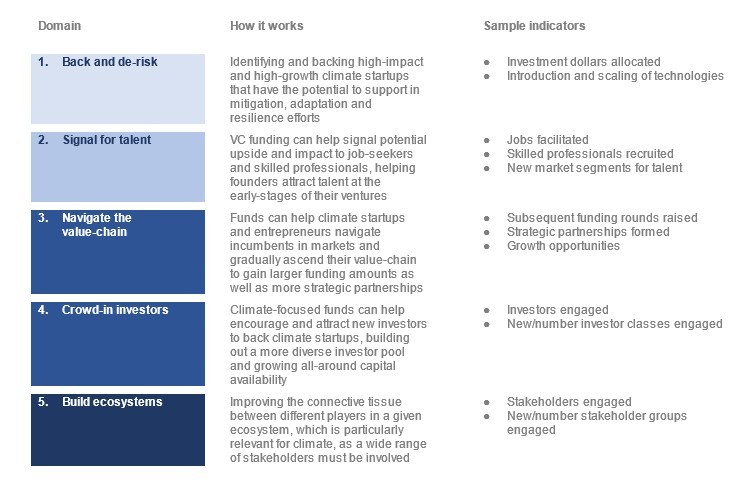 Supporting and Reducing Risk in Established Climate Technologies
Venture capital is fundamentally important in reducing the risks associated with climate technologies. This process can lead to lower costs, faster rates of adoption, and the transformation of markets necessary for a future with reduced carbon emissions.
Successfully tackling the climate crisis depends on supporting entrepreneurs in minimizing technological risks and rapidly scaling their innovations in a financially viable manner.
The venture capital sector is well-positioned to fulfill this function, and its importance is amplified by the extensive range of novel, climate-focused technologies that are currently seeking market acceptance.
Early-stage venture capital, in particular, can have a significant impact by collaborating with companies during their initial phases of development. Successful ventures will subsequently attract substantial growth capital for broader technology deployment.
Daniel Goldman, managing partner at Clean Energy Ventures, emphasized the crucial role of early-stage VCs, stating, “They can provide climate tech startups with both financial resources and specialized knowledge for the commercialization of technologies.”
He further illustrated this point with an example: “Developing a more environmentally friendly method for decarbonizing heavy industry, such as enabling diesel engines to operate on low- or zero-carbon fuels without compromising cost or performance, would substantially benefit sectors like long-haul trucking, agriculture, construction, and backup power systems.”
The Importance of Early-Stage Investment
- Early-stage funding is critical for mitigating initial technology risks.
- Expertise provided by VCs accelerates commercialization.
- Successful startups attract further investment for scaling.
The ability to lower costs and improve performance is paramount for widespread adoption. Technologies that can compete with existing solutions on both price and efficiency are more likely to gain traction in the market.
Ultimately, strategic investment in climate technologies is essential for achieving a sustainable and decarbonized future. Supporting innovation and reducing risk will unlock the potential of these technologies to transform key industries.
Demonstrating Potential to Attract Skilled Professionals
Although gaining increased media attention, the climate tech industry remains relatively nascent and must establish its trustworthiness to attract highly skilled individuals. It stands to reason that every company founder will eventually require a substantial workforce – potentially ranging from dozens to hundreds, or even thousands of employees – to support their vision.
Following the securing of investment, climate-focused startups must then focus on attracting employees. The influx of skilled personnel is paramount to the climate-tech sector’s success, bolstering its standing and ensuring access to top-tier talent.
Susan Su, a partner at Toba Capital, highlights the significant role venture capital plays in establishing legitimacy within climate tech, a crucial factor for prospective employees. “Attracting exceptional talent can be more challenging for early-stage companies lacking VC backing. Initial fundraising serves not only to secure capital, but also to communicate to the wider market – including potential candidates, future employers, and potential acquirers – that the company’s growth trajectory has been vetted by experienced investors,” she explained.
Su posits that VC funding acts as a particularly strong indicator of credibility for pre-revenue and pre-profit startups seeking to gain the confidence of various stakeholders.
The Importance of Early Signals
The initial stages of a company’s development are critical for signaling its potential. A strong signal, such as VC investment, can significantly impact a startup’s ability to recruit effectively.
This signaling effect extends beyond simply attracting employees; it also influences perceptions among partners and potential buyers. Demonstrating investor confidence builds trust and validates the company’s long-term viability.
Talent Acquisition as a Key Metric
Beyond financial capital, the ability to attract and retain talent is a key indicator of success in the climate tech sector. A skilled workforce is essential for innovation and growth.
The competition for talent is fierce, and startups must differentiate themselves to attract the best and brightest. VC backing can provide a competitive edge in this regard.
- Early-stage funding builds credibility.
- Attracting talent is crucial for sector growth.
- VC signals a vetted growth story.
Understanding the Venture Capital Value Chain
Venture Capital (VC) firms and the companies they invest in occupy a foundational position within a broader value chain. This chain begins with nascent business concepts and culminates in a fully realized market encompassing consumers, investors, and strategic alliances.
Typically, VC funds identify and invest in companies during the initial phases of this developmental process. Successful companies demonstrating effective growth strategies are then positioned to secure larger investments in subsequent funding rounds.
Furthermore, growth attracts crucial partnerships and a growing customer base. It’s important to remember that even the most dominant technology companies globally originated at this very starting point of the value chain.
The Funnel Analogy
Robert Murphy, currently a fellow at Breakthrough Energy and previously an economist with the World Bank, conceptualizes this value chain as a funnel. He explains that initial concepts represent the wide top of the funnel.
These early-stage ideas naturally progress towards later stages, requiring increased funding and more impactful strategic collaborations to access and penetrate new markets.
VCs as Early-Stage Catalysts
By actively supporting companies in their formative stages, VCs play a vital role in facilitating a seamless transition for climate-tech businesses as they enter this funnel.
This early championing aims to optimally prepare these companies for the challenges and opportunities inherent in scaling their operations and achieving widespread market adoption.
Attracting a New Wave of Investors
Venture Capital firms are uniquely positioned to motivate investors who haven't yet prioritized climate change. Both established and emerging VC funds investing in climate-focused startups can effectively capture the interest of those currently observing from the sidelines.
According to Manu Schoenfeld, CEO of PowerX, and Andrew Kalish, its head of business development, the initiatives of organizations like Fifth Wall Ventures and their Climate Fund exemplify this approach. Kalish stated, “Fifth Wall’s ability to consolidate capital from prominent real estate companies into a fund specifically dedicated to climate solutions demonstrates how VCs can act as a crucial link between significant industry stakeholders and companies directly addressing climate change.”
A similar pattern has been noted by Clean Energy’s Goldman. He has observed “remarkable openness from a diverse spectrum of investors, encompassing conventional institutions like pension funds, endowments, and insurance companies, as well as substantial family offices and leading financial institutions.”
Goldman further explained that the increasing involvement isn’t limited to asset owners and managers; venture capital is becoming a more significant element within their broader investment portfolios.
The Role of Venture Capital
Venture capital is increasingly recognized as a key component in the investment strategies of various institutions.
This shift indicates a growing understanding of the importance of climate-focused investments.
- Pension funds are allocating capital to climate-tech startups.
- Endowments are integrating climate solutions into their portfolios.
- Insurance companies are recognizing the financial risks and opportunities related to climate change.
The aggregation of capital, as demonstrated by Fifth Wall, facilitates the flow of funds to companies tackling climate challenges.
Bridging the Gap
VCs serve as a vital bridge between established industries and innovative climate-tech companies.
By connecting major industry players with startups, VCs accelerate the development and deployment of climate solutions.
Cultivating a Thriving Environment
Venture capital firms extend their support beyond financial investment, actively facilitating strategic alliances and influencing market development for the companies they back.
Addressing climate change necessitates extensive collaboration among diverse entities – governmental organizations, private businesses, non-profit groups, and academic institutions. According to Murphy, VC funds are ideally positioned to assist startups in forging strategic partnerships, managing complex regulations, and effectively competing against established industry leaders.
Furthermore, these funds can connect various stakeholders, streamlining the process of generating revenue.
Effective climate change mitigation and adaptation strategies will inherently involve multiple parties. Climate-focused VCs, possessing substantial industry knowledge and technical expertise, are uniquely equipped with the networks and agility required to accelerate the formation of these crucial ecosystems.
Strategic partnerships are key to success in this field.
The Role of Venture Capital
- Facilitating connections between startups and established players.
- Providing guidance through regulatory processes.
- Supporting startups in challenging market incumbents.
- Accelerating the path to revenue generation.
The speed at which these ecosystems develop is paramount, and experienced climate VCs are capable of delivering the necessary momentum.
The Future Landscape of Climate Investment
Venture capital is increasingly significant in addressing global climate change, but it represents only one component of a multifaceted challenge. There are inherent limitations to the extent to which VC funding alone can drive comprehensive solutions.
Developing nations, demonstrably, face the greatest risks from climate change while possessing the fewest resources for mitigation. As Goldman observes, although the United States and China generate the largest volumes of carbon emissions, emerging economies require substantial financial and technological assistance to effectively reduce their own emissions.
The expenses associated with decarbonization are projected to be considerably greater in these nations compared to those within the OECD. Schoenfeld echoes this sentiment, noting that even deploying and scaling VC-supported climate technologies proves challenging within the U.S. and EU. Developing countries, hampered by infrastructure limitations and constrained purchasing capabilities, require these solutions but are less able to integrate them.
Unlike most investment sectors judged solely on financial returns, the success of climate tech will be evaluated by its impact on sustaining life and its ability to prevent market dominance by a single entity. Despite being in its nascent stages, there is considerable optimism, and venture capitalists are uniquely positioned to spearhead impactful, scalable, and credible investments in the climate sector.
Goldman highlights the rapid growth in valuations, cautioning against underestimating the long-term potential and the fundamental shift underway. He poses the question: “Are we failing to recognize the immense scale of this opportunity, potentially akin to the Internet, but magnified by a factor of 100, with global implications across all societal sectors?”
Related Posts

Trump Media to Merge with Fusion Power Company TAE Technologies

Radiant Nuclear Secures $300M Funding for 1MW Reactor

Whole Foods to Implement Smart Waste Bins from Mill | 2027

Last Energy Raises $100M for Steel-Encased Micro Reactor

Everbloom AI Transforms Chicken Feathers into Cashmere