AI Spending: Which AI Startups Are Companies Actually Paying For?

Andreessen Horowitz Unveils AI Spending Trends Among Startups
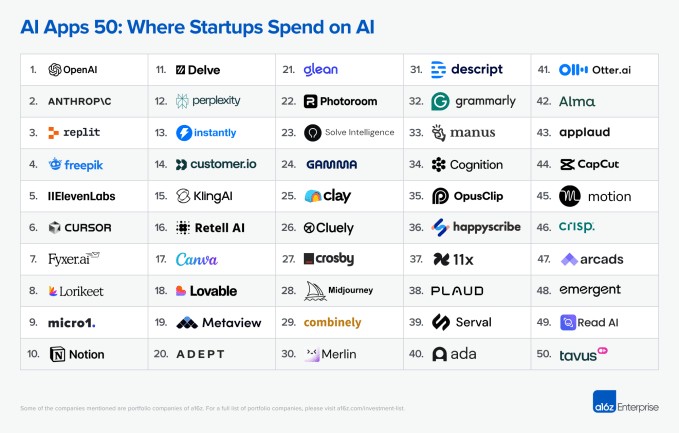
A new report released on Thursday by Andreessen Horowitz (a16z), in collaboration with Mercury, details startup spending on Artificial Intelligence (AI) applications. The report leverages transaction data from Mercury to analyze the top 50 AI-native companies receiving investment from startups, mirroring a previous analysis of the Top 100 Gen AI consumer applications.
Rapid Evolution of the AI Tool Landscape
According to a16z partners Olivia Moore and Seema Amble, the collected data indicates that businesses are currently utilizing a diverse array of AI products for specific functions. They also observed a dynamic market where new applications are rapidly gaining and losing prominence.
“A significant proliferation of tools is evident,” Amble stated. “The market hasn’t yet converged around just one or two solutions within each category.”
Focus on Workforce Augmentation
The report highlights substantial investment in “human augmentors,” often referred to as “copilots,” designed to enhance workforce productivity. This suggests that startups are not yet prepared for a complete transition to fully automated, agentic workflows.
Amble anticipates a shift towards more comprehensive agent tools as computer usage evolves and end-to-end agentic flows become more feasible. “As the ability to create complete agentic flows increases, we expect to see fewer copilots and more end-to-end agent tools,” she explained, “particularly given the eagerness to explore these technologies.”
 Leading AI Companies in Startup Spending
As expected, the leading positions in the report are held by prominent AI labs. OpenAI secured the top spot, followed closely by Anthropic at number two. Tools focused on vibe-coding also demonstrated strong representation, with Replit at number three and Lovable at number eighteen. Cursor ranked sixth, and Emergent occupied the forty-eighth position. Cognition, specializing in enterprise coding tools like Devin and Windsurf, was positioned at number thirty-four.
A comparison with a previous list focused on consumer habits revealed that Lovable had a higher ranking based on traffic alone, due to its popularity for project creation. However, startups are currently allocating more funds to Replit, largely due to its more robust enterprise features. The diversity of companies on the list suggests ample opportunity for multiple players to succeed.
The Future of Vibe Coding
“The future of vibe coding remains an open question,” Moore commented. “Will the market consolidate around a single dominant platform, or will several vibe coding companies thrive, catering to different application types? The answer is currently unclear.”
Unexpected Adoption of Consumer Tools
Moore also expressed surprise at the adoption of consumer-focused tools like CapCut and Midjourney by startups.
“We are observing a trend where consumer companies are rapidly being integrated into enterprise environments,” Moore noted. “This is driven by the creation of exceptionally user-friendly consumer tools that individuals then adopt within their teams and workplaces.”
 Horizontal vs. Vertical Applications
Horizontal applications accounted for at least 60% of the companies listed, while vertical applications comprised the remaining 40%. The most popular vertical software companies concentrated on sales, recruiting, and customer service. The report also indicated AI’s growing impact in sectors that previously presented challenges for startups.
“What were once service firms or consultancies are now evolving into software companies in the age of AI,” Moore explained.
Crosby Legal was cited by Amble as an example, offering rapid review of legal contracts, effectively replacing traditional consultations with in-house counsel. Currently, most AI tools function as aids to employees, accelerating decision-making, rather than fully automating workforces.
“As the technology improves and we can develop complete agent coworkers, the balance will shift towards end-to-end agents and away from copilots,” she added, noting AI’s potential to perform tasks like outreach more efficiently than humans.
The Rise of Note-Taking Applications
The report also featured numerous note-taking applications, including Otter.ai, Read AI, and HappyScribe, without a single option achieving market dominance. This reinforces Amble’s observation that startups are still selecting “their own flavor” of tools based on individual preferences. This variety benefits employees, allowing them to choose applications that best suit their workflows, rather than being limited to a standardized product.
 Blurring Lines Between Consumer and Enterprise
The report revealed a growing convergence between consumer and enterprise businesses. Individuals are integrating personal applications into their work, and companies are leveraging their preferred personal tools to build their businesses. Previously, a clear distinction existed between the two, with separate technology stacks for startup development.
Canva was highlighted as an example, transitioning from a popular consumer app to a significant enterprise player. It took years for Canva to introduce an enterprise plan, but the increasing overlap between use cases is driving companies to blend consumer and enterprise offerings.
“Your total addressable market is no longer limited to one or the other; you can now target both,” Amble explained. She also suggested that companies building these products may “professionalize” more rapidly, developing enterprise teams focused on go-to-market strategy, sales, and support to accelerate revenue generation.
A Dynamic and Evolving Market
Moore and Amble anticipate significant changes in the list over the coming years. Established companies are integrating AI features to remain competitive, while new entrants are introducing innovative ideas.
“‘Legacy players’ now means what existed just 12 months ago,” Amble said. “If we revisit this report in a year, will the same note-taking apps still be present, or will a completely new set of applications emerge?”
This article was updated to reflect information regarding note-taking applications.
Related Posts

ChatGPT Launches App Store for Developers

Pickle Robot Appoints Tesla Veteran as First CFO

Peripheral Labs: Self-Driving Car Sensors Enhance Sports Fan Experience

Luma AI: Generate Videos from Start and End Frames

Alexa+ Adds AI to Ring Doorbells - Amazon's New Feature