App Spending Surges: $32B in Q1 2021
App Spending Reaches New Heights in Q1 2021
The app industry experienced a significant surge in 2020, and this momentum has continued into 2021. A recent report from App Annie reveals that consumer expenditure within apps reached a record-breaking $32 billion during the first quarter of this year.
Record-Breaking Consumer Spending
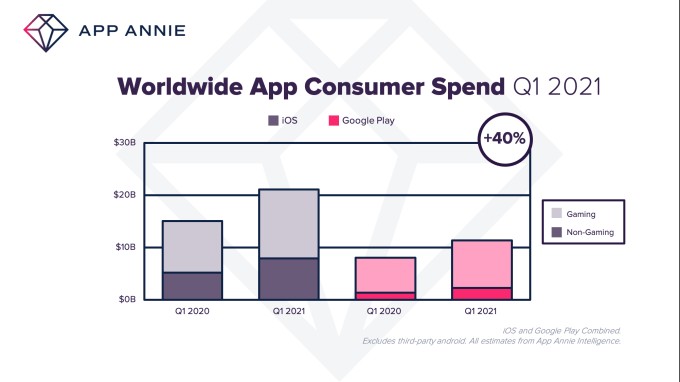
This figure represents a 40% increase compared to the $23 billion spent in Q1 2020. It marks the largest quarterly total ever recorded for app spending, according to App Annie’s analysis.
Pandemic-Driven Growth
The increase in both app downloads and consumer spending last year can be directly linked to the widespread adoption of apps during coronavirus lockdowns. People increasingly relied on applications for work, education, shopping, fitness, entertainment, and gaming.
Previously, App Annie reported a total of 218 billion global app downloads and $143 billion in consumer spending for the entirety of 2020.
 Spending Trends Across Platforms
Mobile consumers spent approximately $9 billion more in Q1 2021 than in Q1 2020. Both the iOS App Store and Google Play Store saw a 40% growth rate in consumer spending.
However, the specific app categories driving this spending differed between the two platforms.
Category Performance
On Google Play, the strongest growth in consumer spending was observed in the Games, Social, and Entertainment categories. For iOS, Games, Photo & Video, and Entertainment apps demonstrated the most significant gains.
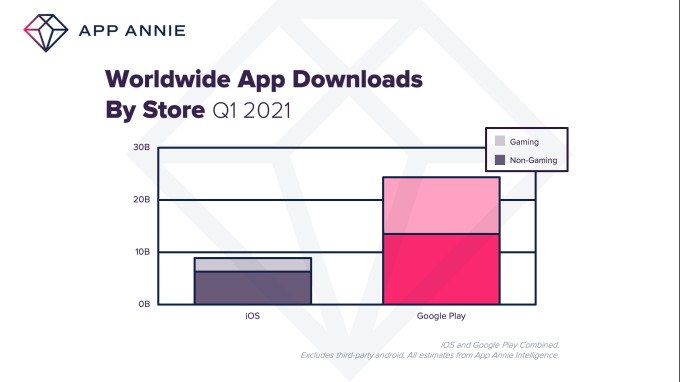
Download trends also varied. Google Play saw growth in Social, Tools, and Finance apps, while iOS downloads were boosted by Games, Finance, and Social Networking applications.
Notably, Google Play experienced a 40% increase in Weather app downloads and a 35% rise in Dating app downloads. iOS saw a 25% growth in Health and Fitness app downloads, likely influenced by New Year’s resolutions and continued stay-at-home lifestyles.
 Top Apps in Q1 2021
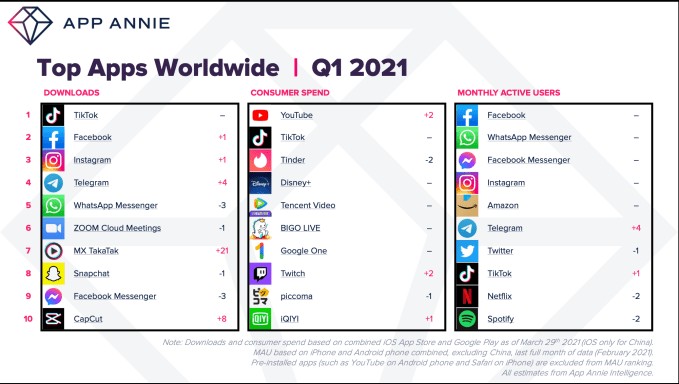
TikTok led in terms of downloads, surpassing Facebook, followed by Instagram, Telegram, WhatsApp, and Zoom. However, YouTube topped the charts for consumer spending, with TikTok securing the second position.
Other high-ranking apps included Tinder, Disney+, and Tencent Video. Netflix’s position has shifted as it now encourages direct sign-ups rather than in-app purchases.
 Market Leadership and Emerging Apps
Despite being surpassed by TikTok in downloads, Facebook’s suite of apps – including Facebook, WhatsApp, Messenger, and Instagram – maintained the lead in monthly active users (MAUs). TikTok ranked eighth in this metric.
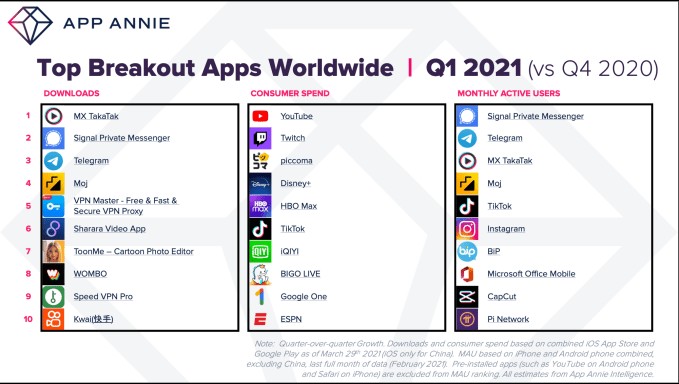
Signal, a privacy-focused messaging app, experienced the most substantial growth in both downloads and MAUs, identified by App Annie as a “breakout app.” Telegram also saw significant gains following events after the Capitol riot.
MX TakaTak emerged as another “breakout” app, filling the void left by the ban of TikTok in India.
 Gaming Dominance
Gaming continued to be the primary driver of spending, accounting for $22 billion of the total – $13 billion on iOS (a 30% year-over-year increase) and $9 billion on Android (a 35% year-over-year increase). Approximately one billion game titles were downloaded each week, representing a 15% increase from 2020.
Join Clash 3D replaced Among Us! as the most downloaded game, while DOP 2: Delete One Part climbed 308 places to reach the third position.
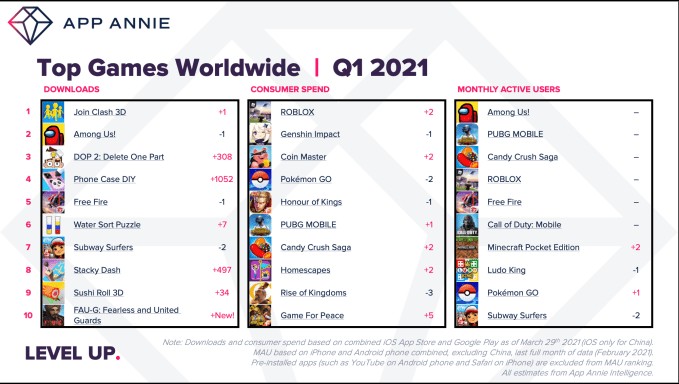 Roblox led in consumer spending, followed by Genshin Impact, Coin Master, and Pokémon GO. Despite a decline in downloads, Among Us! remained the most popular app by monthly active users, followed by PUBG Mobile, Candy Crush Saga, and Roblox.
App Annie predicts that the mobile gaming market will reach $120 billion in consumer spending this year, exceeding all other gaming formats combined by 1.5x. The pandemic has undeniably accelerated the growth of this sector, with game downloads outpacing overall downloads by 2.5x in 2020.
Related Posts

Peripheral Labs: Self-Driving Car Sensors Enhance Sports Fan Experience
YouTube Disputes Billboard Music Charts Data Usage
Oscars to Stream Exclusively on YouTube Starting in 2029
Warner Bros. Discovery Rejects Paramount Bid, Calls Offer 'Illusory'

WikiFlix: Netflix as it Might Have Been in 1923