Gatik, Torc & NVIDIA Partner to Advance Self-Driving Technology
Nvidia Advances Autonomous Driving Technology
The recent Nvidia GTC conference served as a platform for significant announcements concerning the company’s contributions to the field of autonomous driving.
Nvidia supplies both automotive manufacturers and companies specializing in autonomous vehicles with a suite of proprietary tools. These tools are designed to facilitate the development of self-driving cars and the creation of digital replicas of manufacturing facilities.
Several companies, including Torc, Gatik, and General Motors, revealed their intentions to integrate Nvidia products into their operations. This integration spans from robotics utilized in warehouses to the implementation of automated driving systems.
Understanding Nvidia’s Terminology
To clarify the various brand names associated with Nvidia’s hardware and software, a concise glossary of key terms is provided below:
- Drive AGX: This represents Nvidia’s high-performance in-vehicle computer, responsible for processing sensor data in real-time.
- Drive Orin SoC: A more sophisticated system-on-a-chip, Orin functions as a central processing unit. It manages data from multiple sensors and enables Level 4 autonomous capabilities in new vehicles.
- Drive Thor SoC: Representing a further advancement, Thor is specifically optimized for Transformer architecture. This allows for the incorporation of generative AI and supports a wide range of functions, including self-driving, cockpit control, and infotainment.
- DriveOS: Nvidia’s safety-centric operating system for its autonomous vehicle platform, DriveOS ensures secure, real-time AI processing and the integration of advanced driving and cockpit features.
- Omniverse: This is Nvidia’s simulation platform, enabling automakers to develop and operate intricate, AI-driven virtual environments. It supports synthetic data generation, AV software testing, and the construction of digital twins for factories.
- Cosmos: Cosmos is engineered to facilitate world model training for the physical AI development of both autonomous vehicles and robotic systems.
Furthermore, Nvidia introduced Halos, described as an AI-driven safety system for autonomous vehicles and future physical AI applications, such as humanoid robots.
Halos integrates numerous Nvidia automotive hardware and software safety solutions, functioning as a comprehensive safety framework.
Additional announcements regarding Nvidia’s automotive advancements were made on the second day of the GTC conference.
General Motors
A broadened collaboration between General Motors and Nvidia has been revealed, encompassing all facets of the automotive manufacturer’s operations. This partnership extends to production facilities, robotic systems, and the development of autonomous vehicles.
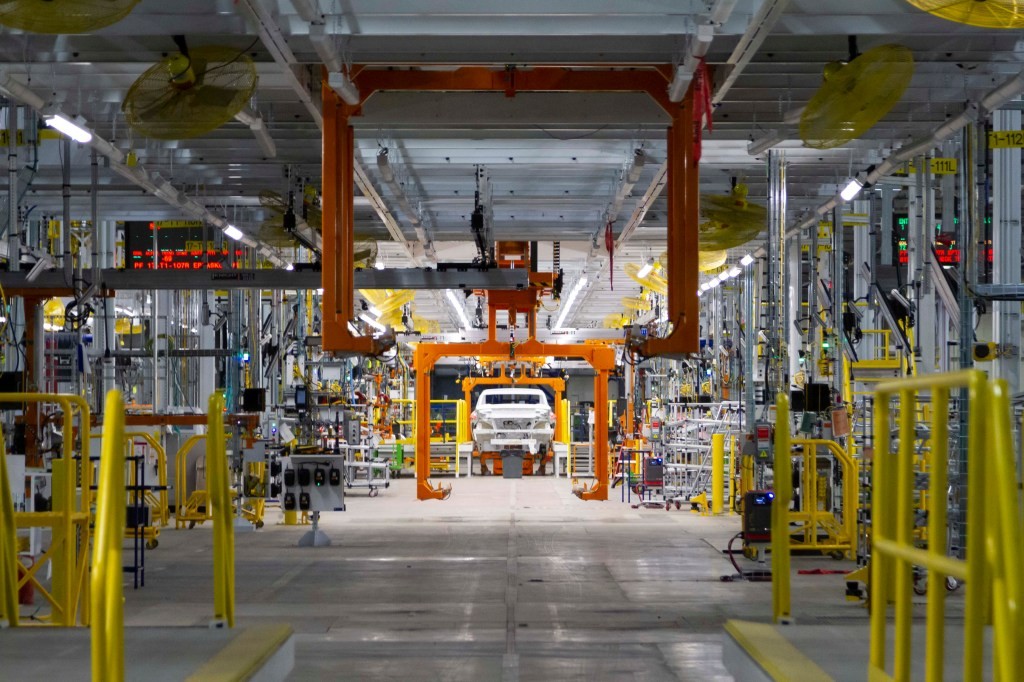
GM intends to leverage Omniverse, integrated with Cosmos, to develop and refine AI models for manufacturing processes. This will facilitate the construction of advanced factory infrastructure. The utilization of Omniverse will enable GM to create a digital replica of its plants.
Through this digital twin, new production methodologies can be rigorously tested in a virtual environment, avoiding any interruption to current vehicle assembly lines. Furthermore, robotics platforms will be trained using Omniverse for tasks such as material logistics and internal conveyance.
Regarding autonomous driving technology, GM will integrate Nvidia’s Drive AGX platform into the hardware architecture of its future vehicles. This integration will support both sophisticated driver-assistance features and enhanced in-cabin safety systems.
Gatik
Gatik, a firm specializing in autonomous trucking, has become a participant in Nvidia’s automotive ecosystem. The company, which receives support from Isuzu and Goodyear Ventures, focuses on self-driving box trucks for middle-mile logistics.
Based in Silicon Valley and Toronto, Gatik intends to integrate and utilize Nvidia’s Drive AGX platform, enhanced by Drive Thor, as the central AI processing unit for its entire truck fleet.
Furthermore, Gatik is leveraging the DriveOS system to run its proprietary AI models, prioritizing safety in its operations.
Accelerated Deployment of Autonomous Trucks
This collaboration is expected to expedite the widespread implementation of Level 4 autonomous trucks. This will benefit Gatik’s customer base, which includes major retailers and food suppliers.
Among Gatik’s key clients are prominent names such as Walmart, Kroger, and Tyson Foods, all of whom stand to gain from more efficient and reliable logistics solutions.
The integration of Nvidia’s technology is a significant step towards scaling autonomous trucking capabilities and delivering enhanced services to these industry leaders.
Plus and Cosmos: Advancing Autonomous Trucking
Plus, a company specializing in autonomous trucking software, announced on Tuesday a collaboration with Cosmos to leverage their world foundation models.
This partnership is intended to expedite the testing and refinement of SuperDrive, Plus’s autonomous driving system.
SuperDrive System Architecture
The SuperDrive system utilizes multiple Nvidia Drive Orin SoCs as its foundational hardware components.
According to David Liu, co-founder and CEO of Plus, current production deployments are based on the Orin system.
The company is also actively preparing for future integration of Thor systems, working closely with its hardware suppliers.
Strategic Partnerships and Commercialization
Plus has established key partnerships with leading commercial vehicle manufacturers.
These collaborations include agreements with the Traton Group, IVECO, and Hyundai, all focused on integrating SuperDrive technology into their respective truck fleets.
Testing of the autonomous technology is currently underway on public roads in both Texas and Sweden.
The company is aiming for a full commercial launch of SuperDrive by the year 2027.
Accelerated Development with Cosmos
The integration of Cosmos world foundation models is expected to significantly accelerate the development process.
This will allow Plus to enhance the capabilities and reliability of SuperDrive more efficiently.
Torc
Torc, a company focused on autonomous trucking, has revealed a collaboration with Nvidia to engineer a scalable, physically-based AI computing infrastructure for its autonomous vehicles (AVs). The Virginia-based firm, which operates as a subsidiary of Daimler Truck AG, is also partnering with Flex, a manufacturer specializing in automotive-grade computing platforms.
According to Torc, the development process leverages a combination of Nvidia’s chip architectures. This includes the Drive AGX, Drive Orin, and DriveOS systems, all intended to facilitate the implementation of self-driving functionalities. The company is targeting a commercial rollout of its technology by 2027.
A significant milestone was reached in October 2024 when Torc successfully completed its inaugural driverless test on a dedicated track located in Texas.
Volvo
Volvo is leveraging Nvidia’s advanced Blackwell GPUs, not for automated driving collaboration, but to enhance the efficiency of its aerodynamics simulations.
Improved aerodynamic performance is crucial, particularly in electric vehicles (EVs), as it directly contributes to increased battery range by minimizing drag.
Simulation Partnership
Instead of utilizing Nvidia’s Omniverse platform, Volvo has partnered with Ansys, a leading software simulation firm, to evaluate the speed of their aerodynamic simulations.
Ansys’s “Fluent” software is specifically designed to take advantage of the processing power offered by Nvidia’s Blackwell GPUs, significantly accelerating the simulation process.
EX90 Aerodynamic Optimization
Volvo and Ansys employed a computer-aided design (CAD) model of the EX90 as input for Fluent simulations.
This collaborative effort resulted in a substantial reduction in simulation runtime, decreasing from 24 hours to just 6.5 hours.
The accelerated simulations enable Volvo to conduct numerous design iterations daily, leading to optimized vehicle designs and a faster time to market.
Note: This report has been revised to provide further clarity regarding Ansys’s technology and the application of Nvidia chips by Plus.
Related Posts

ChatGPT Launches App Store for Developers

Pickle Robot Appoints Tesla Veteran as First CFO

Peripheral Labs: Self-Driving Car Sensors Enhance Sports Fan Experience

Luma AI: Generate Videos from Start and End Frames
Alexa+ Adds AI to Ring Doorbells - Amazon's New Feature