Lucid Motors SPAC Deal: Going Public at $24 Billion
Lucid Motors to Go Public via SPAC Merger
Lucid Motors has finalized an agreement to become a publicly listed company through a merger with Churchill Capital IV Corp., a special-purpose acquisition company. This represents the largest transaction to date involving a blank-check company and an electric vehicle (EV) startup.
Financial Details of the Merger
The resulting combined entity will be valued at $11.75 billion in transaction equity. Saudi Arabia’s sovereign wealth fund will maintain its position as the largest shareholder. Private investment in this public equity offering is set at $15 per share, implying a pro-forma equity value of $24 billion.
A Trend of EV SPAC Mergers
Lucid’s move follows a series of similar mergers involving other EV startups, including Arrival, Canoo, Fisker, and Lordstown Motors. Furthermore, several companies focused on EV infrastructure, such as EVgo and ChargePoint, have also entered the public market through SPAC deals.
Market Reaction and Stock Performance
Lucid was arguably the most highly anticipated of these ventures. Intense speculation in the weeks leading up to the announcement caused Churchill Capital IV Corp.’s stock price to surge over 470% from its initial $10 share price since January 2021. However, following the deal’s details being revealed, the share price experienced a decline of over 30%.
Funding and Expansion Plans
The merger will provide Lucid with approximately $4.4 billion in total funding. This capital injection will accelerate and broaden the company’s strategic initiatives.
Lucid intends to commence production and deliveries of the Lucid Air in North America during the latter half of the current year. This represents a shift from the previously projected timeline of spring deliveries. The Air is slated for release in Europe in 2022 and China in 2023.
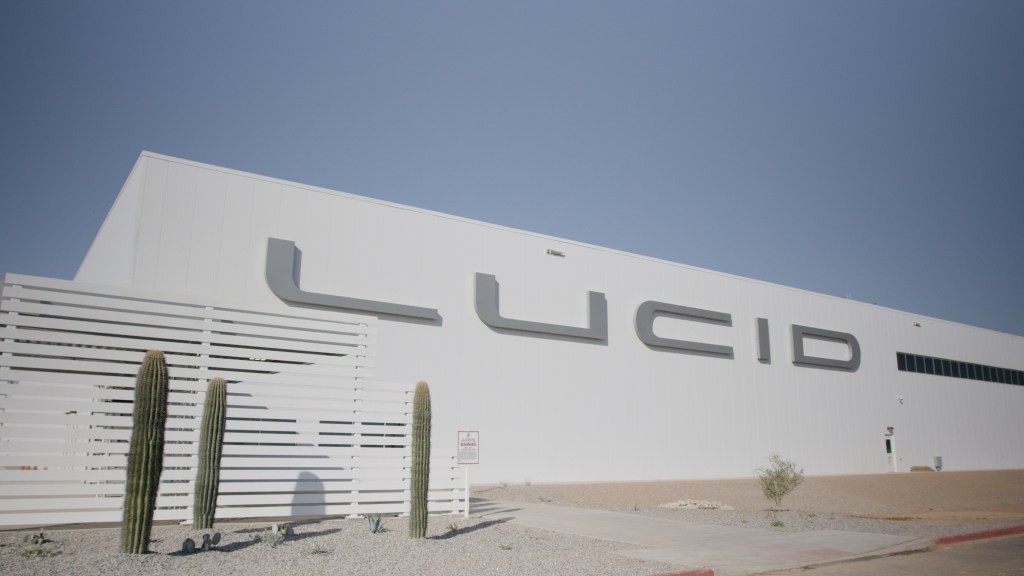
The Gravity, a performance luxury SUV, is anticipated to enter the North American market in 2023. Vehicle production will take place at Lucid’s newly established factory in Casa Grande, Arizona.
Factory Expansion and Technological Advancement
According to Lucid CEO and CTO Peter Rawlinson, the funding will also facilitate the expansion of the Arizona factory and support the launch of these new vehicles. The company envisions expanding the facility through three additional phases to achieve an annual production capacity of 365,000 units. The initial phase, completed late last year, has a capacity of 30,000 vehicles annually.
The investment will also enable Lucid to pursue its goal of supplying EV technologies to other automotive manufacturers and offering energy storage solutions for residential, commercial, and utility applications.
Lucid’s Path to Production
Successfully scaling an EV company presents significant challenges. Lucid faced near-collapse several years ago while seeking the necessary capital to bring the Lucid Air sedan to production. Ultimately, Saudi Arabia’s sovereign wealth fund provided a crucial $1 billion investment in September 2018.
Company History and Evolution
Lucid originated in 2007 as Atieva, a company founded by Bernard Tse, a former Tesla VP and board member, and entrepreneur Sam Weng. Its initial focus was on developing advanced battery technology for electric vehicles. This early research and development laid the foundation for the future Lucid, which formally emerged in 2016 with the stated aim of producing electric vehicles.
Peter Rawlinson, who joined Lucid as CTO in 2013 after leaving Tesla, played a pivotal role in this transformation, later assuming the role of CEO.
Competitive Positioning
While often compared to Tesla, Rawlinson has stated that the Lucid Air is designed to compete with the Mercedes S Class, the flagship luxury vehicle from the German automaker. Lucid positions itself as “post luxury,” targeting established luxury brands like Audi, BMW, and Mercedes-Benz, rather than directly competing with Tesla’s innovation.
Future Product Strategy
Lucid intends to follow a similar strategy to Tesla by planning to introduce more affordable EV models as production scales up.
Peter Rawlinson will continue to serve as both CEO and CTO. The transaction is projected to be finalized in the second quarter of the year.
Related Posts

Trump Media to Merge with Fusion Power Company TAE Technologies

Radiant Nuclear Secures $300M Funding for 1MW Reactor
Coursera and Udemy Merger: $2.5B Deal Announced

X Updates Terms, Countersues Over 'Twitter' Trademark
Slate EV Truck Reservations Top 150,000 Amidst Declining Interest