TuSimple to Test Driverless Trucks on Public Roads
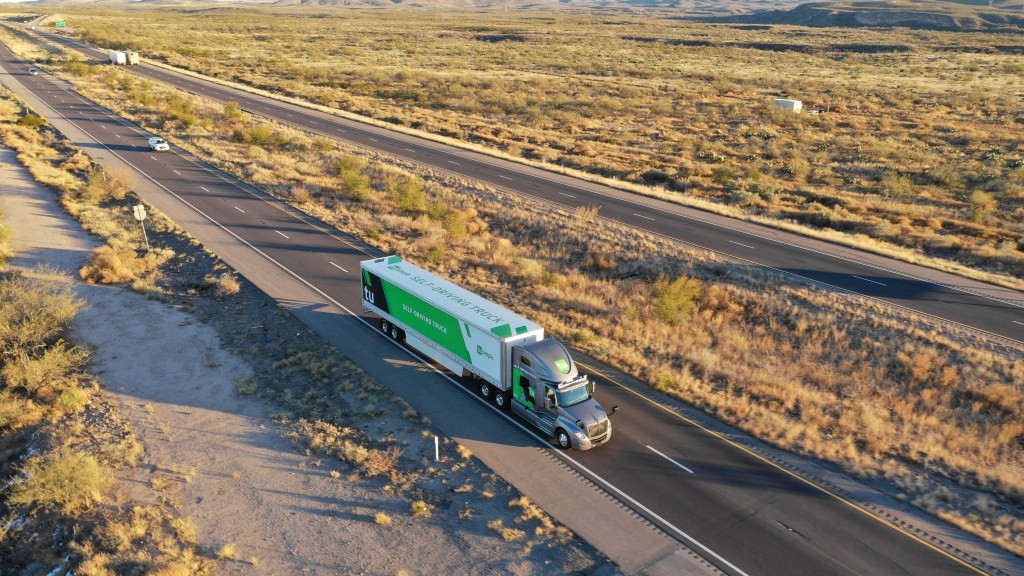
TuSimple Advances Towards Driverless Trucking on Public Roads
TuSimple, a startup focused on self-driving truck technology, has indicated it is nearing the stage of testing its system on public roads without a human safety operator. The company anticipates initiating these tests before the year concludes.
Driver-Out Pilot Program Details
During the company’s third-quarter earnings call, TuSimple announced its intention to move forward with a driver-out pilot program. This program will initially focus on an 80-mile route connecting Phoenix and Tucson, Arizona.
“We anticipate completing the initial driverless runs prior to the end of the year and finalizing the pilot program in the coming months,” stated Cheng Lu, President and CEO of TuSimple, during the call.
The driver-out pilot will involve numerous runs conducted over several weeks. It represents a crucial component of the company’s ongoing technological advancement across software, hardware, and market strategies.
Addressing Challenges of Autonomous Operation
A significant challenge lies in accounting for both anticipated and unforeseen circumstances encountered on public roadways. These include vehicles failing to comply with traffic laws, unexpected road construction, and fluctuating driving conditions.
All these factors require continuous monitoring and real-time adjustments to ensure safe operation.
Competitive Positioning
Successfully launching this program before 2022 will position TuSimple as a leader in the autonomous trucking sector.
Kodiak Robotics is currently limiting driver-out testing to closed tracks. Embark is not yet testing on public roads without a safety driver, with plans for a pilot program in 2023 and commercial operations by 2024.
Waymo Via is presently testing with two autonomous specialists in the vehicle, rather than in a “rider-only” mode. Einride, a Swedish freight company, has operated driverless trucks in Europe for several years, but will initially restrict driverless operations in the U.S. to the closed campus of its partner, GE Appliances.
Technology Development and Safety Validation
TuSimple plans to “freeze” its technology development in the coming weeks. This will allow for final test runs on open roads with a safety driver and on a test track without any human presence.
This test phase will be instrumental in validating the company’s safety case.
Following complete safety validation, the team will proceed with removing the driver for the 80-mile public road run.
Two-Pronged Safety Approach
TuSimple’s safety case validation centers around two key areas: “Systems safety” and “Operations safety.”
Systems safety focuses on ensuring the reliability, fail-safeness, sufficiency, and proven performance of each system component. Operations safety concentrates on establishing and validating safe processes and procedures for all driver operations.
“Operation Safety validates that we have monitored and triaged every driving event that we can, assessed the event’s level of safety risk and assigned it for resolution by engineering teams,” explained Lu.
Supply Chain and Scaling Challenges
Beyond the pilot program, TuSimple acknowledges challenges in the Tier 1 supply chain, which could impact the deployment of additional vehicles.
Near-term obstacles include supply chain disruptions and labor shortages. Long-term, the primary challenge is the maturity of the supply chain for autonomous technology components.
Investment in the Supply Chain
The company recognizes a “chicken-and-egg” situation, where Tier 1 suppliers are hesitant to invest without firm orders. TuSimple is actively addressing this risk by increasing investment in the supply chain.
“Over the next coming quarters, you’ll hear more announcements from us in terms of investing more heavily in the supply chain to ensure that we can meet the timeline that we talked about,” Lu stated.
Financial Performance and Revenue Growth
In Q3, TuSimple invested $85 million in R&D, a $24 million, or approximately 3x, increase year-over-year. A significant portion of this investment was allocated to hiring technical talent and additional drivers.
The company attributes its ability to exceed revenue expectations of $1.65 million, achieving $1.8 million in Q3 revenue, to increased personnel and the commercial utilization of its fleet and autonomous freight network (AFN) partner fleets.
Despite a net loss per share of $0.54, exceeding the expected $0.49, TuSimple increased its revenue mile growth by 2.5x, reaching approximately 945,000 miles, up from around 379,000 miles in Q3 of the previous year.
Expansion of Freight Lanes and Mapping Efforts
TuSimple is mapping new freight lanes with UPS, extending operations from Arizona to Florida.
The company plans to expand its AFN across the United States by 2024, and has partnered with Ryder to facilitate this expansion.
TuSimple is collaborating with UPS Supply Chain Solutions to accelerate AFN expansion to the east coast, reaching UPS North America Air Freight (NAAF) terminals in Orlando and Charlotte, where high-definition routes have already been mapped.
Fuel Savings and Mapping Technology
Since 2019, TuSimple’s partnership with UPS has resulted in the completion of 160,000 miles of freight hauls for NAAF, yielding a 13% reduction in fuel consumption at speeds between 55 and 68 miles per hour.
In Q3, the expansion of the AFN from Dallas to Charlotte involved mapping 1,400 new unique miles, bringing the total unique miles mapped to 9,900.
TuSimple anticipates continuous improvements in map quality due to new mapping technology that enables dynamic, low-latency updates, reducing update times from weeks to days, and ultimately to minutes.
Related Posts

Trump Media to Merge with Fusion Power Company TAE Technologies

Radiant Nuclear Secures $300M Funding for 1MW Reactor
Coursera and Udemy Merger: $2.5B Deal Announced

X Updates Terms, Countersues Over 'Twitter' Trademark
Slate EV Truck Reservations Top 150,000 Amidst Declining Interest