Twitter API for Researchers: New Platform Access

Twitter is currently launching a new dedicated pathway within its API platform, as part of a comprehensive overhaul of the Twitter API. This new offering is specifically designed to support the requirements of the academic research community, providing expanded access to the Twitter archive and reduced limitations on data retrieval, enabling researchers to explore the complete record of public discourse on the Twitter platform.
Alongside access to all Twitter API v2 endpoints currently available, and enhanced privileges, researchers will benefit from more refined search functionalities.
In particular, they will be able to utilize the full-archive search endpoint, granting access to the totality of conversations occurring on Twitter. Researchers can refine their searches for historical tweets by specifying start and end dates.
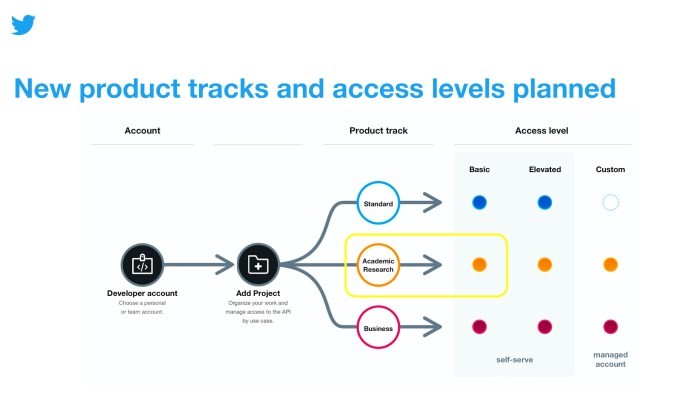 Researchers will also receive a substantially increased monthly allowance for the number of tweets they can obtain through the Twitter API v2. While the Basic access level provides a limit of 500,000 tweets, the Academic Research track offers an initial monthly cap of up to 10 million tweets. This increased limit applies to the Recent Search, Filtered Stream, Full-archive search, and user tweet and mentions timelines endpoints, according to Twitter.
The Academic Research track will also have access to specific operators not generally available, with the intention of facilitating the extraction of more precise user data. Currently, these include: $ (also known as cashtag), bio, bio_name, bio_location, place, place_country, point_radius, bounding_box, -is:nullcast, has:cashtags and has:geo.
When utilizing the filter stream endpoint, researchers can implement 1,000 concurrent rules, a significant increase from the 25 rule limit in the Standard track. Queries within the recent search endpoint can extend to 1,024 characters, compared to the 512 character limit in the Standard track.
Due to the elevated access levels provided, individuals seeking access to the Academic Research product track must first submit a formal application.
All applicants must hold the status of a master’s student, doctoral candidate, post-doctoral researcher, faculty member, or research employee at a recognized academic institution or university. They must also present a well-defined research objective and clearly outline their plans for utilizing, analyzing, and disseminating Twitter data derived from their research.
Furthermore, Twitter clarifies that the data obtained through the Academic Research product track cannot be employed for any commercial applications.
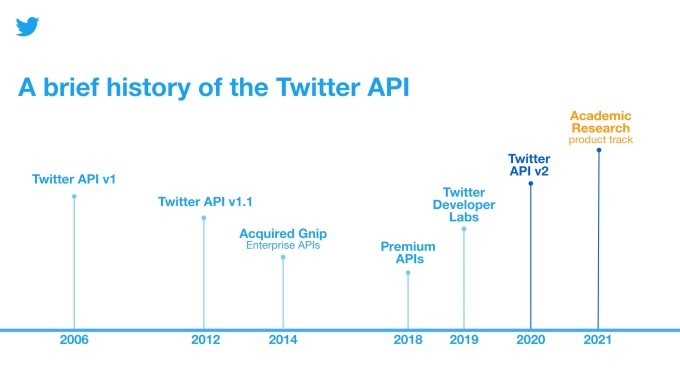 Twitter states that academic researchers have been leveraging the Twitter API since its initial release in 2006, utilizing the data to investigate a diverse range of subjects, including state-sponsored campaigns to disrupt public discourse, the impact of floods and climate change, public attitudes and perceptions regarding COVID-19 and initiatives to foster constructive online interactions.
However, the previous iteration of the Twitter API presented challenges for researchers seeking access to Twitter data—an issue the company aimed to address with API v2.
Twitter has previously supported the research community through various means, such as a dedicated website for academic research, updates to its developer policy to enhance reproducibility and validation of research, and specialized endpoints, like the COVID-19 stream endpoint launched in April 2020. However, it hadn’t fully developed, until API v2, tools specifically designed to assist researchers in their work, rather than requiring them to overcome Twitter’s inherent limitations.
The Academic Research product track underwent private beta testing beginning in Oct. 2020, and is now being made available more broadly on a free-of-charge basis.
Twitter intends to introduce higher levels of access across all its product tracks in the future, including this one, over time. These expanded levels will cater to researchers requiring even greater data volumes than currently offered with this initial release. Twitter also mentioned it is exploring the implementation of flexible access options, which would accommodate fluctuations in data consumption throughout the year.