Retail Media Spending Surge: What's Driving Growth?

The Shift to Online Retail and the Rise of Retail Media
The impact of the COVID-19 pandemic on businesses is now widely understood. Many experienced declines in traditional, in-store sales, alongside a surge in demand for remote work arrangements.
Fluctuating customer traffic due to lockdown measures further accelerated a pre-existing trend: the growth of e-commerce.
Numerous brands found themselves needing robust online infrastructure that they hadn't previously prioritized.
Southeast Asia's E-commerce Boom
A significant number of consumers across Southeast Asia are increasingly choosing online platforms – such as Shopee, Lazada, Tiki, and Tokopedia – over traditional shopping malls.
Consequently, advertising expenditure is shifting to align with these changing consumer habits.
This trend is currently driving the emergence of retail media in developing markets.
The Pioneering Role of Amazon and Market Potential
Amazon established the initial framework for retail media in North America in 2018 with the launch of Amazon Advertising, a self-serve, bid-based marketplace.
Boston Consulting Group (BCG) currently estimates that retailers stand to gain a $100 billion revenue opportunity by capitalizing on this evolving landscape.
Success, however, will depend on their ability to adapt and effectively implement retail media strategies.
Advertising Spend Follows Consumer Behavior
A crucial factor in predicting future advertising expenditure lies in understanding the evolution of contemporary marketing practices.
Modern marketing isn't confined to traditional methods like bus stop ads. It encompasses a diverse range of strategies, including Google keyword bidding, participation in platforms like Clubhouse, and the potential for viral content on TikTok.
As the distinction between the physical and digital worlds diminishes with increasing connectivity, marketing now integrates all available channels, measured by key performance indicators.
The Core Objective of Marketing
The fundamental aim of marketing, irrespective of the chosen channel, remains consistent: to present a business or its offerings to the most relevant consumers, ultimately driving sales.
Like any endeavor, marketing can be approached ineffectively, adequately, or optimally.
Historically, traditional marketing relied heavily on linear television, radio broadcasts, and printed media due to their widespread popularity.
However, the advent of the internet introduced new avenues such as email marketing, company websites, and streaming services.
Subsequently, the proliferation of social media and mobile applications dramatically reshaped the advertising landscape.
Despite these ongoing transformations, one principle has remained constant: businesses consistently position themselves where their target audience is most active.
Shifting Budgets Reflect Changing Consumer Habits
Consequently, when patterns of consumer traffic and revenue generation undergo shifts – perhaps triggered by events like a pandemic – marketing strategies adapt accordingly.
Data from Nielsen indicates that over the next year, a significant number of marketers intend to reduce investment in cinema advertising, print media, and out-of-home (OOH) advertising.
Conversely, the majority plan to allocate increased budgets to social media and search engine marketing.
Identifying Leading Advertising Platforms
The shifting of advertising budgets prompts the question: which channels are poised for growth? Examining ad revenue patterns in established markets, such as the United States, provides valuable insight. Although Google and Facebook currently hold the largest share of the advertising market, Amazon has demonstrably increased its portion of revenue within the U.S., rising from 7.8% to 10.3% in 2020 alone, as reported by eMarketer.
This growth is attributable to the fact that the most effective advertising channels are those offering the greatest number of quantifiable interactions with consumers.
Traditional media like television, radio, and print offer only a single point of contact before losing the consumer’s attention. Conversely, websites and email campaigns can track clicks, but lose the ability to monitor behavior once a user leaves the platform. Ad networks and social media platforms achieved dominance by tracking consumer interests and movements across diverse platforms, and by utilizing this data to re-engage users with tailored advertising designed to drive conversions.
Despite the continued effectiveness of numerous advertising tools, many rely on third-party cookies, which are facing increasing restrictions due to concerns regarding digital privacy. The diminishing relevance of cookie-based tracking restricts advertisers’ capacity for re-targeting, the creation of similar audience segments, and ad personalization.
With intensifying competition and the growing prevalence of performance marketing, the capacity to accurately measure return on ad spend (ROAS) is essential for achieving scalability and profitability. Recent data from Nielsen indicates that nearly 50% of global marketers still lack confidence in their ROI measurement capabilities, often focusing on metrics like brand awareness or reach, or facing challenges in accurate attribution due to conversions occurring outside the advertising channel.
This lack of transparency in ROI hinders swift executive decisions, results in inefficient marketing expenditure, and ultimately limits potential sales opportunities.
Amazon's Ascendancy as an Advertising Powerhouse
While Amazon’s prominence in e-commerce is well-established, its burgeoning influence within the advertising landscape has often been less recognized than its achievements in logistics and cloud computing.
E-commerce presents a distinctive advertising avenue, encompassing the complete consumer experience from initial interest to final purchase, particularly as marketplaces increasingly capture search share from traditional search engines.
Marketplaces possess detailed insights into shopper intentions, purchase frequency, average spending habits per product category, and geographic location.
Furthermore, they maintain consistent communication with customers via email, push notifications, interactive games, chat features, live streaming events, and shipping notifications.
Consequently, digital retailers are now accumulating substantial amounts of first-party data.
Leveraging On-Site Marketing Tools
Utilizing on-site marketing solutions, brands can strategically position their products directly before the point of sale, targeting specific customer demographics.
This allows for precise performance analysis, identifying the most effective keywords, optimal pricing strategies, peak sales periods, and the impact of product thumbnail variations on click-through rates (CTR).
Brands can then refine their campaigns based on this data-driven feedback.
The Value of Direct Consumer Interaction
The increasing importance of direct consumer engagement is exemplified by Netflix’s recent launch of its own online store.
Each additional interaction point with the end consumer significantly enhances the channel’s overall value.
- More touchpoints mean more data.
- More data leads to better targeting.
- Better targeting drives increased sales.
This shift highlights a fundamental change in the advertising ecosystem, where control of the consumer journey is paramount.
Navigating the Challenges to E-commerce Success in Southeast Asia
The onset of the COVID-19 pandemic significantly accelerated the adoption of e-commerce by businesses throughout Southeast Asia, resulting in increased demand for skilled professionals. Continued lockdowns implemented in key nations like Singapore, Malaysia, Thailand, Vietnam, and Indonesia underscore the importance of establishing a strong initial presence in retail marketing to expedite online growth.
As e-commerce evolves into a premier marketing avenue, realizing its full potential hinges on marketplaces providing brands with both appropriate tools and comprehensive data. In Southeast Asia, platforms such as Shopee, Lazada, and Tokopedia have begun offering marketing solutions – including keyword bidding and sponsored product listings (like MyAds and Sponsored Search) – to sellers. However, these solutions are still undergoing refinement.
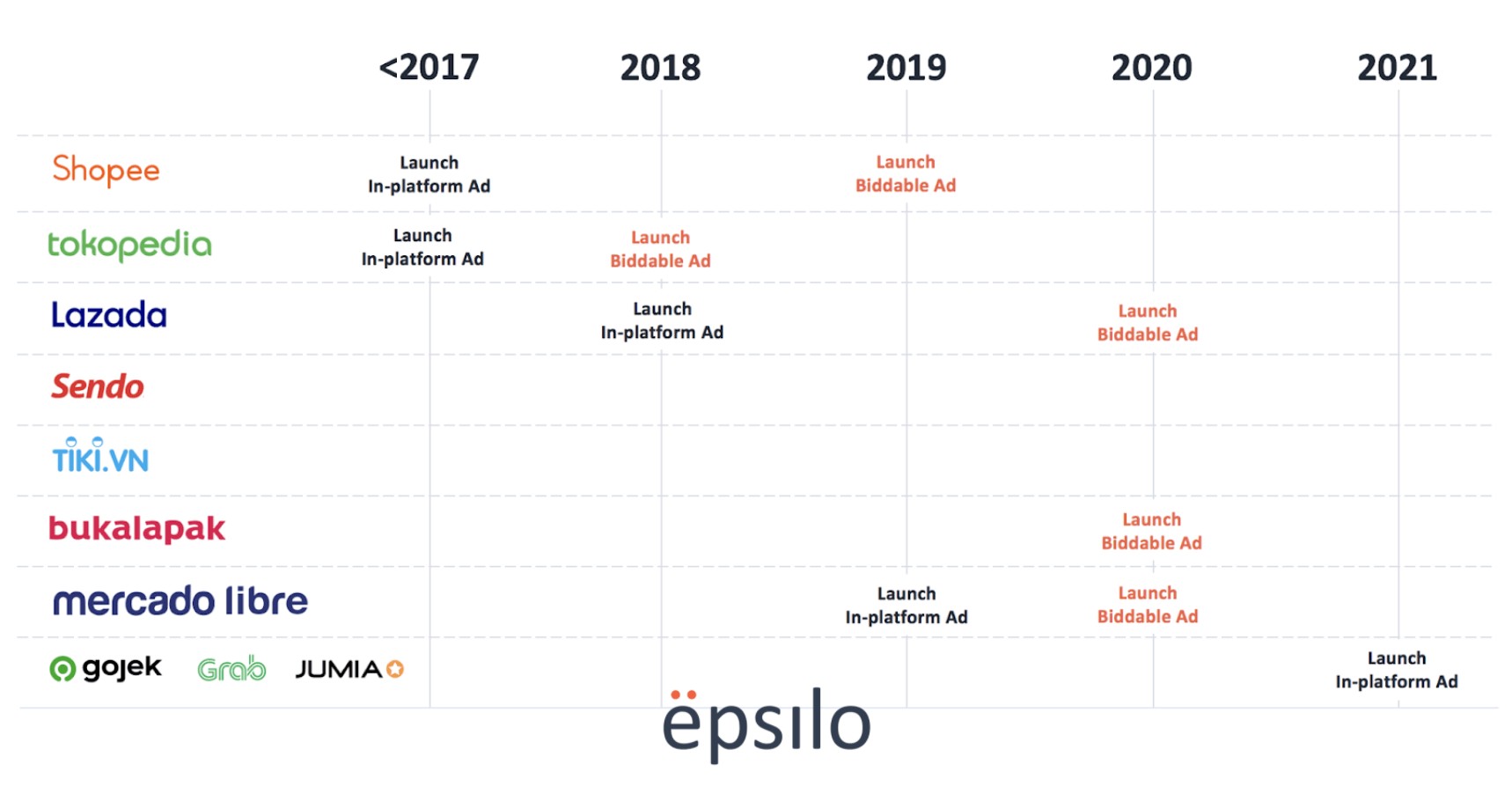 A significant challenge for Southeast Asian sellers is achieving scalability, a contrast to the experience of sellers on Amazon in Western markets. This difficulty stems from the fragmented nature of the region, which features nine distinct marketplaces, each holding strengths within specific local markets. Success in Southeast Asian e-commerce necessitates a presence and active engagement across all major retailers.
Quang Tran, founder and CEO of Epsilo – a Sequoia India’s Surge Accelerator-backed e-commerce marketing SaaS solution – notes, “Unlike other regions dominated by Amazon, merchants in Southeast Asia typically operate across more than three or four marketplaces within the six key markets, due to the absence of a single dominant player.” He continues, “Clients frequently report that their marketing teams are overwhelmed by extensive portfolios, demanding campaign schedules, and limited tool functionality.”
In Amazon-centric markets like the U.S. and Europe, companies like Helium10, Stackline, and Jungle Scout are already widely utilized to automate advertising processes, enhance Return on Ad Spend (ROAS), gather competitive intelligence, and consolidate e-commerce analytics into a unified platform.
To capitalize on the emerging marketing trends in Southeast Asia, three crucial elements are required for effective retail media utilization:
- Software: What specialized tools can empower a business to execute more efficiently and deliver tailored reports with actionable metrics for rapid decision-making? Prioritize software that offers customization and a rich feature set, rather than a one-size-fits-all approach.
- Data: What data is accessible through the marketplace? Are key performance indicators (KPIs) being accurately tracked to facilitate continuous improvement of campaigns? While GMV and ROAS are vital, metrics like CVR (conversion rate), CTR (click-through rate), and IS (items sold) are equally important.
- Talent: Does the organization possess the necessary expertise to interpret insights and adjust strategies when performance falls short of expectations? If securing skilled personnel proves difficult or costly, can technology be leveraged to automate routine tasks?
The COVID-19 pandemic spurred a resurgence in e-commerce activity. However, it will be those businesses that swiftly adapt to a data-driven and technologically advanced environment that can transform retail media into a $100 billion market reality.
Related Posts

Peripheral Labs: Self-Driving Car Sensors Enhance Sports Fan Experience

YouTube Disputes Billboard Music Charts Data Usage
Oscars to Stream Exclusively on YouTube Starting in 2029

Warner Bros. Discovery Rejects Paramount Bid, Calls Offer 'Illusory'

WikiFlix: Netflix as it Might Have Been in 1923