Will the Pandemic Reshape Cities? A Smart Rebirth?

The Enduring Strength of Cities in a Post-Pandemic World
Historically, cities have functioned as vibrant centers for living, working, and recreation. The onset of the pandemic prompted an exodus from larger cities to smaller towns, leading to speculation regarding the long-term viability of urban areas.
While widespread reopenings and herd immunity are still some time away, predictions of the demise of major cities may be premature.
Global Urbanization Trends
United Nations projections indicate that by 2030, approximately two-thirds of the global population will be city dwellers. These communities serve as focal points for culture, innovation, economic prosperity, education, and tourism, among other advantages.
Cities are not merely deserving of preservation; they are poised for revitalization. This expectation is reflected in the anticipation among U.S. municipal leaders that the Biden administration will dedicate significant funding to the reconstruction of existing infrastructure, with a focus on equitable access.
The Role of Technology in Urban Renewal
A renewed emphasis on inclusivity and social progress presents an opportunity for the technology sector to tackle various challenges related to lifestyle and well-being.
These include issues concerning infrastructure, transportation, public safety, environmental monitoring, and energy distribution.
Smart City Technologies: A Look Ahead
As cities undergo a period of reassessment, what smart city technologies will fundamentally alter our daily lives? What technological advancements will have the most substantial impact on urban environments within the next year?
Which cities are currently leading the way in smart city initiatives?
Insights from the SmartCityX Survey
To address these questions, the SmartCityX Survey was conducted, gathering input from industry experts. Participants included smart city investors, corporate and municipal leaders, academics, and startups actively involved in urban innovation.
The survey aimed to provide valuable perspectives on the future direction of urban development. Key findings from the survey are presented below:
- The resilience of cities is stronger than initially anticipated.
- Investment in infrastructure is crucial for equitable urban growth.
- Technology plays a vital role in addressing urban challenges.
The Primacy of Infrastructure in Urban Development
The condition of critical infrastructure represents the most significant challenge confronting modern cities. This concern is closely followed by issues related to traffic and transportation networks.
While Cisco’s involvement in this sector may have diminished, numerous other companies, including a burgeoning number of startups, are actively pursuing and benefiting from the potential for expansion within this field.
Supporting Data Points
Several recent developments underscore this trend, particularly concerning the need for infrastructure rebuilding, the integration of the Internet of Things (IoT), and the development of open toolkits designed to connect previously disparate technologies.
- Bentley Systems, having recently completed an Initial Public Offering (IPO) in September, has unveiled a $100 million corporate venture capital fund.
- Qualcomm has announced the launch of its IoT Services Suite, a comprehensive offering that encompasses leading-edge solutions.
This suite includes advancements in wireless connectivity, specialized hardware, sophisticated software, robust data analytics, and seamless platform integration.
These initiatives demonstrate a growing commitment to addressing the infrastructural needs of cities and leveraging innovative technologies to create more efficient and connected urban environments.
Forces of Transformation in Urban Environments
A significant consensus emerged when respondents were asked to identify the key drivers of innovation and change within cities. The COVID-19 pandemic was overwhelmingly indicated as the foremost catalyst, closely followed by the rise of remote work.
This shift to remote work has expedited the integration of digital collaboration platforms and compelled established organizations to rapidly finalize digital transformation initiatives that previously spanned several years.
The Opportunity for Urban Renewal
The most substantial prospect lies in reconstructing cities with enhanced intelligence and efficiency. This involves prioritizing new infrastructure designed for optimized resource utilization.
For many, this revitalization process fundamentally centers on the home environment.
The Ascendancy of the At-Home Economy
The at-home economy, significantly propelled by technological advancements, has taken a dominant position across various sectors, including telemedicine, education, and fitness.
This trend demonstrates considerable staying power and is not expected to diminish in the foreseeable future.
Even with the gradual reopening of urban centers, the home is poised to remain the definitive multi-functional space for individuals.
It will continue to serve as a central hub for a wide range of activities.
The Foremost Influence: Smart Data in the Next Year
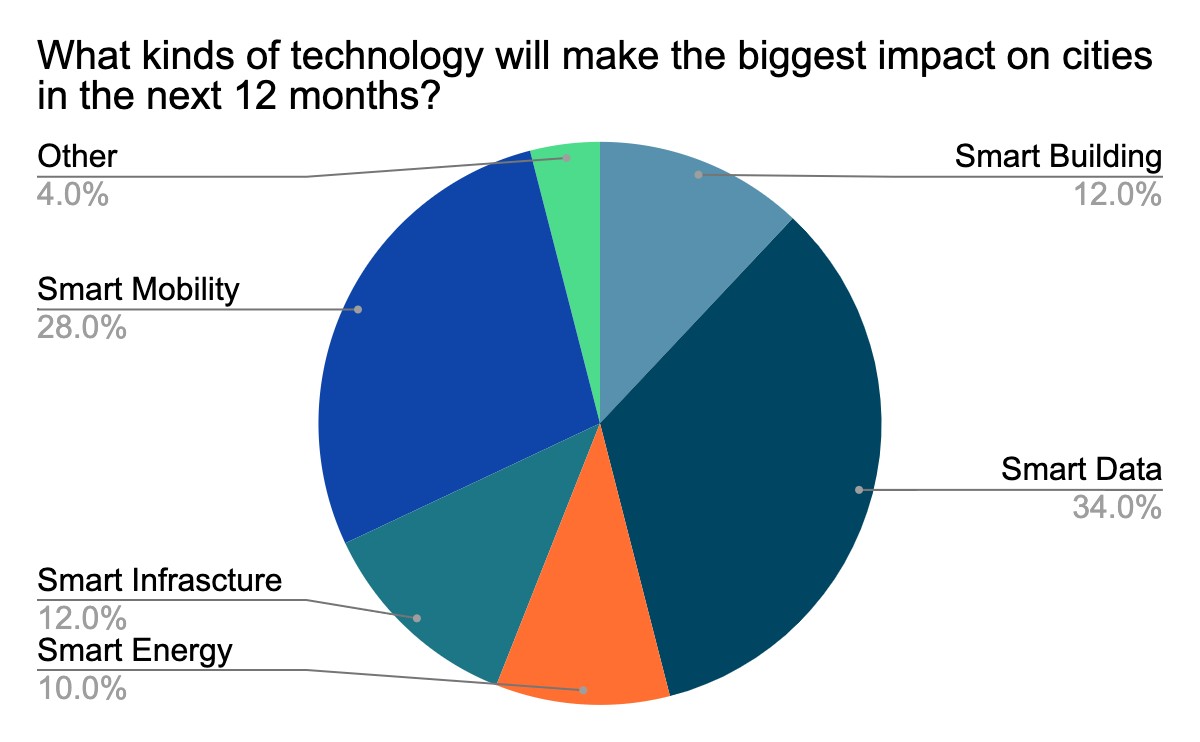
Recent surveys indicate that smart data is projected to have the most significant impact on the smart city sector within the coming year.
Specifically, 34% of those surveyed identified smart data as the leading technology.
This encompasses the data collection capabilities of IoT-connected sensors and devices.
Current Implementations of IoT Technology
Many cities are already deploying IoT devices across diverse locations.
These range from street-level traffic monitoring systems to facilities assessing water quality in aqueducts.
Smart mobility, focused on improving transportation, secured the second-highest ranking with 28% of the vote.
The Role of IoT in Urban Development
While relying solely on IoT for solutions is improbable, it will be a crucial component in the progress and interconnectedness of urban infrastructure.
Its integration is essential for realizing the full potential of smart cities.
 The image illustrates the potential for urban renewal through smart technologies.
It highlights the evolving landscape of city management.
Advancing Fairness and Inclusion in Urban Environments
A significant majority of those surveyed (90%) anticipate that smart city technologies will foster greater equity and inclusivity in urban life. This transformation can occur through various mechanisms.
For example, smart city solutions can ensure all citizens have comparable access to municipal services.
Furthermore, these technologies can facilitate resident involvement in local governance and allow broader participation in the city’s economic prosperity.
Improving Health and Education Outcomes
Smart city technologies also present opportunities to address health disparities. Remote diagnostic capabilities and health monitoring systems can specifically benefit communities of color, which experience a disproportionately high incidence of chronic illnesses.
Digital learning platforms can bridge educational gaps, connecting students from historically disadvantaged areas with high-quality educational resources.
The Role of Investment and Networking
Beyond the technological aspects, the venture capital sector plays a crucial role in supporting inclusive urban development.
Investing in minority-owned businesses is essential, but financial support alone is insufficient.
A more impactful contribution involves leveraging and extending valuable relationship networks.
Facilitating access to growth opportunities is a profoundly meaningful gesture.
Conversely, restricting access to these connections is detrimental and reflects a lack of social responsibility.
Such behavior is comparable to resource hoarding and is both unethical and regrettable.
The New U.S. Administration's Priorities: Economic Growth and Sustainability
Survey data indicates that economic development (50%) is anticipated to be the primary concern for the incoming U.S. administration regarding urban areas. This expectation is logical, considering the significant increase in poverty levels resulting from the recent pandemic.
Alongside economic concerns, sustainability (28%) and improved healthcare access (16%) are also identified as key priorities.
Looking Ahead: Smart City Progress
Despite ongoing efforts in smart city adoption, both investors and survey respondents suggest that demonstrable outcomes are still three to five years away. A lack of sufficient funding is cited as the most significant obstacle.
Following closely behind funding challenges are issues related to legislation, policy, and concerns surrounding privacy and security. Many innovative technologies developed by smart city companies are still in the maturation process, and widespread city implementation requires considerable time.
As the need for smart city solutions grows, Singapore stands out as a leading example. A study conducted by IMD, a Swiss business school, and the Singapore University of Technology and Design, ranked Singapore as the world’s smartest city.
Singapore provides infrastructure focused on public health, including pedestrian-friendly walkways, subterranean parking facilities, and expansive green areas. The city’s Land Transit Authority has broadened the scope of its autonomous vehicle pilot program to encompass all of western Singapore, offering accessible and affordable transportation options.
Furthermore, the Singaporean government proactively provides its citizens with complimentary fitness trackers.
The pandemic presents a unique opportunity to unite the smart city community and rejuvenate urban centers. The goal is to create more habitable, sustainable, and inclusive environments.
Cities are only truly valuable if we are prepared to re-evaluate how we support the varied communities within them. Through innovation, investment, and dedicated effort, we can collaboratively build the cities of tomorrow, fostering environments where all residents can flourish.
Related Posts

Trump Media to Merge with Fusion Power Company TAE Technologies

Radiant Nuclear Secures $300M Funding for 1MW Reactor

Whole Foods to Implement Smart Waste Bins from Mill | 2027

Last Energy Raises $100M for Steel-Encased Micro Reactor

Everbloom AI Transforms Chicken Feathers into Cashmere